
DECONSTRUCTING THE BEATLES
THE TV SERIES
Join “Beatle-ologist” Scott Freiman in a journey through the band’s development.
Check listings for your local PBS station, or watch any time with the PBS Passport app.
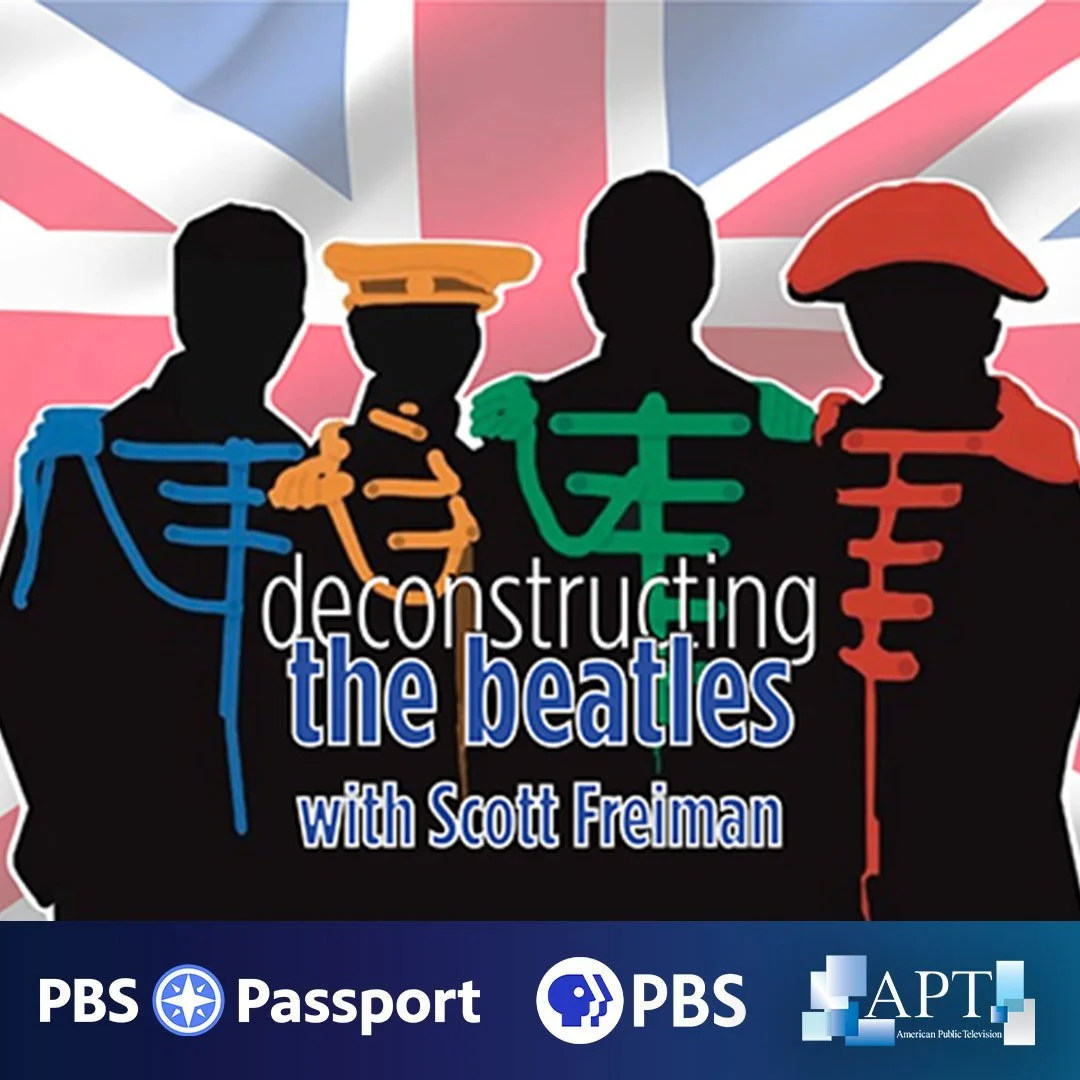
Join creator and host Scott Freiman for “Deconstructing the Beatles.” Distributed by American Public Television (APT), the program can be seen on select public television stations. It is also available to stream with Passport on pbs.org and the PBS App.
“It is almost as if Scott was in the recording studio with the Fab Four with the extensive knowledge he has about the band,” said APT’s David Rubinsohn. “His insights are phenomenal and it’s so much fun to uncover new perspectives on their timeless music.
“I like to take apart the creative process,” explains Freiman, “to discover what makes these songs and records so great. It’s really as close as you can get to being there with the band.”
“These programs have been road-tested and proven over the course of more than a decade,” according to Co-Executive Producer and CultureSonar founder Al Cattabiani. “Scott has honed his presentations carefully, so they appeal to fans of all kinds and all ages. It’s really a joy to behold.”
YEAR ONE EPISODES
The Beatles Come to America — The story of how The Beatles went from Liverpool to the Ed Sullivan Show
Deconstructing Rubber Soul — The race against the clock to produce 1965’s Rubber Soul
A Trip Through Strawberry Fields — A look at the origins and recording of the Beatles’ masterpiece “Strawberry Fields Forever”
YEAR TWO EPISODES
Deconstructing “A Hard Day’s Night” — An exploration of the film A Hard Day’s Night, and the music written for the film
A Stroll Through Penny Lane — A look at the origins and recording of the Beatles’ masterpiece “Penny Lane”
Here Comes the Songs: The Evolution of George Harrison — An overview of the songwriting career of George Harrison
About American Public Television:
American Public Television (APT) is the leading syndicator of high-quality, top-rated programming to the nation’s public television stations. Founded in 1961, APT distributes 250 new program titles per year and more than one-third of the top 100 highest-rated public television titles in the U.S. APT’s diverse catalog includes prominent documentaries, performance, dramas, how-to programs, classic movies, children’s series and news and current affairs programs. Doc Martin, Midsomer Murders, America’s Test Kitchen, Rick Steves’ Europe, The Best of the Joy of Painting with Bob Ross, My Life is Murder, Pati’s Mexican Table, Christopher Kimball’s Milk Street Television, Legacy List with Matt Paxton, Table for All with Buki Elegbede, Lidia’s Kitchen, Kevin Belton’s New Orleans Kitchen, Lucky Chow, NHK Newsline, BBC News and Biz Kid$ are a sampling of APT’s programs, considered some of the most popular on public television. APT also licenses programs internationally through its APT Worldwide service and distributes Create®TV — featuring the best of public television's lifestyle programming — and WORLD™, public television’s premier news, science and documentary channel. More information at APTonline.org
About CultureSonar and LGC Studios:
CultureSonar is a community for grown-up music lovers. Its daily blog and socials attract a loyal, engaged audience, with millions of cumulative annual impressions. Lorraine Gregory Communications (LGC) develops TV series, commercials, motion graphics, set design, editing, live streaming, and on-location and studio production. Together, LGC and CultureSonar have produced Woodstock: 50 Years Later– seen on over 160 PBS outlets, Living Light for Japan’s national broadcaster, NHK, and the TV version of Deconstructing the Beatles, for Maryland Public Television.
COMPLETE EPISODE DESCRIPTIONS
Ep. 101 - The Beatles Come to America
While the craze known as "Beatlemania" had taken over the U.K., in the fall of 1963, the Beatles were practically unknown in America. Through the efforts of band manager Brian Epstein, TV host Ed Sullivan, and a teenage fan from Silver Spring, Md., all of that would change by February 1964. By the time The Beatles arrived at JFK Airport on February 7, 1964, "Beatlemania" was a full-blown phenomenon in America. Their first appearance on The Ed Sullivan Show garnered 73 million viewers, making it one of the most-watched shows in television history. Featured songs include "I Want to Hold Your Hand," "She Loves You," and "All My Loving."
Ep. 102 - Deconstructing Rubber Soul
In October 1965, The Beatles faced an impossible task: produce a new album of original music in time for a Christmas release. Within a month, they had emerged with what many consider to be one of their greatest albums – Rubber Soul. They even had time to create a Double A-side single, “We Can Work It Out,” backed by “Day Tripper.” Both sides, as well as the album, hit No. 1 on the charts. Composer/producer/”Beatle-ologist” Scott Freiman walks fans through the creation of Rubber Soul – and the band’s day-by-day race against the clock. Featured songs include "Drive My Car," "Day Tripper," "In My Life," "Nowhere Man," "Michelle," and "Girl."
Ep. 103 - A Trip Through Strawberry Fields
In August of 1966, after years of relentless touring, the Beatles found themselves grappling with inadequate sound systems, raucous, screaming fans, and the inability to hear themselves play. Their music was getting increasingly complex, but it could not be performed live due to the limitations of the technology of the time. And so, John Lennon, Paul McCartney, George Harrison, and Ringo Starr made the pivotal decision to stop touring. This could have spelled the end for the Beatles. Instead, they used this critical moment to embark on a new artistic direction, pushing the boundaries of songwriting and recording. The song that started it all – "Strawberry Fields Forever'' – began with a melancholic John Lennon strumming his guitar in a small apartment in Almería, Spain.
Ep. 201 - Deconstructing A Hard Day’s Night
Host Scott Freiman explores how The Beatles’ first feature film grew from a quick commercial opportunity into a groundbreaking cultural milestone. Through rare audio examples, musical analysis, and behind-the-scenes stories, Scott traces the band’s whirlwind rise in 1963–64; the creation of the film with director Dick Lester and screenwriter Alun Owen; and the recording of unforgettable songs like “I Should Have Known Better,” “Can’t Buy Me Love,” “And I Love Her,” “Tell Me Why,” and “If I Fell.” He breaks down the innovative techniques that shaped the movie’s irreverent style, the origin of its title, and the studio wizardry behind the iconic title track. The episode culminates in the film’s premiere, critical acclaim, and lasting influence, showing how A Hard Day’s Night captured The Beatles at the very moment they transformed from rising stars into cultural icons.
Ep. 202 - A Stroll Through Penny Lane
Host Scott Freiman explores the origins, composition, and recording of The Beatles’ nostalgic masterpiece, revealing how a simple Liverpool roundabout inspired one of the Beatles’ most vivid musical portraits. Scott traces the song’s roots in the band’s decision to stop touring, their desire to create a Liverpool-themed studio album, and the shared childhood memories that shaped its characters and imagery. He examines the dual interpretations of “Penny Lane” —as both a real place filled with barbers, bankers, firemen, and nurses, and a magical landscape that exists “in your ears and in your eyes”—before diving into McCartney’s inventive chord progressions, the song’s unusual two-key structure, and its climactic “truck driver’s gear change.” Scott also unpacks the innovative studio techniques behind its layered pianos, harmonium, brass and woodwind arrangements, and the iconic piccolo-trumpet solo performed by David Mason. The episode concludes with the release of the “Strawberry Fields Forever” / “Penny Lane” double A-side and how these landmark recordings set the stage for Sgt. Pepper’s Lonely Hearts Club Band.
Ep. 203 - Here Come the Songs – The Evolution of George Harrison
Host Scott Freiman traces Harrison’s remarkable artistic journey from eager teenage guitarist to groundbreaking songwriter, musical innovator, and spiritual seeker. Scott explores Harrison’s early struggles to emerge as a composer within Lennon and McCartney’s towering partnership, his growing mastery of unusual chord progressions and philosophical lyrics, and his pioneering introduction of Indian music into Western pop through songs like “Norwegian Wood” and “Within You Without You.” The episode follows Harrison’s deepening study of Eastern music and spirituality, his rhythmic ingenuity in pieces like “Here Comes the Sun,” his heartfelt songwriting breakthroughs such as “Something,” and his flowering as a solo artist with All Things Must Pass and “My Sweet Lord.” Scott also examines Harrison’s work with Indian musicians, his embrace of the Moog synthesizer, his leadership in the Concert for Bangladesh, and his joyful late-career resurgence with the Traveling Wilburys. Throughout, the episode reveals how Harrison grew from the “quiet Beatle” into a powerful creative force whose musical and spiritual legacy continues to resonate.